Tag:

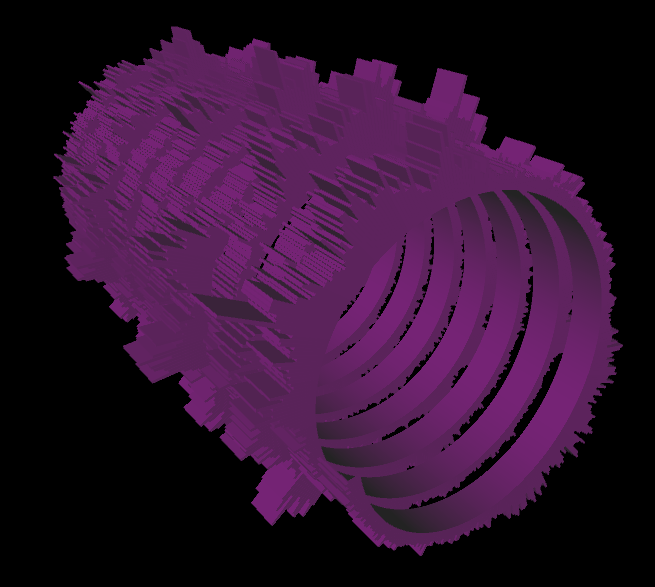
NYLON CityBlob

by pixelpusher on Thursday 5 June 2008
[Software, Blog]

A software art project that remixes the skylines and sights of cities I’ve lived in and visited.  Download at: NYLONCityBlob

NYLON CityBlob

Awhile back, in 2006, I put my lifelong obsession with New York City’s buildings to good use. 2006 was the year my wife and I moved to London to start a new life as expatriates, reversing the colonial journey that started our home country in favor of the old country on the edge of a new, powerful-again Europe.

Leaving New York, I felt like a traitor. New York is in my family’s blood. My grandfather loved nothing more than to take us around the sights - the Empire State, the Twin Towers, Macy’s, the countless delicatessens shining as culinary diamonds in the rough preserve of Mexicans making Chinese food and Chinese baking Pizzas. My grandfather spent all his years in New York, knew every inch of the serpentine BQE (Brooklyn-Queens-Expressway) slithering over and through industrial Brooklyn on its way up north to upstate and sweet oblivion, finally exploding into the Hutch, the Cross-Bronx, and the Bruckner.

Not that he would have ventured that far north - he hated grass, and crickets. Especially crickets.

I don’t want to give the impression that my family is parochial; they’re well-traveled and world-wise, but they always come back. I still haven’t returned.

I ‘ve turned my world travels into an art project - just as the skylines of all the places I’ve visited and lived get jumbled in my head over time, this software remixes them and rescales them and blends them into a chimera of a city. I’ll add to it over time but right now it is NY (New York City) LON (London). Sometimes it gets intimate, and small places crowd out the big, important, impersonal ones. Use the mouse to navigate. Mac-only (for now). Enjoy.

If you’d like to show it somewhere, please contact me at pixelpusher@flkr.com, I’m open to the idea.

No Comments Digg del.icio.us

offset circles take two

by pixelpusher on Sunday 27 April 2008
[Software, Blog]

offset circles take two image
Originally uploaded by da mad pixelist on flkr

I’ve been playing with the offsetcircles patch from before, and came up with a whole bunch of nice results. Taking a page from Claude, I made the drawing recursive (hmm… makes me want to use Scheme…) and rendered out these two short videos. These are fun experiments in basic, rotary motion. Its really amazing what fun you can have with simple math, rotations, and some blending.

There’s also this one.

Here’s the actual sketch plus code (the last version, anyway):

No Comments Digg del.icio.us

Area10 Media Lab Gig

by pixelpusher on Sunday 13 April 2008
[images, Blog]

the beardos

Originally uploaded by yaxu


Yaxu (Alex McLean of http://lurk.org) captured this great shot from Area 10 Medialab launch gig this weekend. I have a nice hi-res video of the event, plus some of the other performances, which I’ll upload soon. I also have some great audio and video (audio straight from the soundboard, really clean and clear as a mountain spring) from the last Immersion that I’ve been meaning to post. My computer had a Quicktime meltdown, but is back in fine working shape again and ready to spend hours rendering quality video once more.

UPDATE: Oli (yesyesnono.com) has some more photos

Some video and more can be found here

One Comment Digg del.icio.us

minesweeper.tv gig 4 April 2008

by pixelpusher on Friday 4 April 2008
[Past Performances, Performances]

I’ll be doing a visuals set to the sounds of Robert Atwood and Jag (variseq+electronics v.s. din) on 4th April 2008 for a fundraiser at the minesweeper.tv boat. A whole host of others will be playing as well, and it will run from 6pm until midnight. More details TBA.

UPDATE: Lots of good details can be found on Lurk.org

No Comments Digg del.icio.us

Sine-Line visual experiments

by pixelpusher on Tuesday 1 April 2008
[Blog]

sine line sketch 01

Some works-in-progress I’ve been experimenting with - simple, colorful audio streams filtered according to frequency, sometimes rendered as 3D geometric shapes. I’ll be performing this with Rob A. and Jag at the Minesweeper gig coming up.

Read on for more images

No Comments Digg del.icio.us
tagged , , , and

Rotating circles after Duchamp Man Ray Picabia

by pixelpusher on Tuesday 25 March 2008
[Software, Blog]

Offset Circles (after Duchamp, Picabia, Man Ray)

You’ve probably heard of Marcel Duchamp, Man Ray, and Picabia. If you haven’t, and especially if you have, and you happen to live somewhere near London, go directly to the Tate Modern to see their new exhibition of their combined works, do not pass go, do not collect $200. This exhibit is so chock full of major works that you can easily get lost, or worse, distracted.

From the Tate Modern exhibition website:

In the 1920s Duchamp ostensibly gave up making art works to play competitive chess. But he was fascinated by the idea of creating virtual forms. Helped at times by Man Ray, he experimented with stereoscopic views and built a number of devices that generated the illusion of seeing a drawing or design in three dimensions.

The devices that “generated the illusion of seeing a drawing or design in three dimensions” consist of what look like CAD drawings on circular plates; circles of increasing diameter nestled inside one another, filling the whole disc, or filling part of the disk along with the skeleton of a 3D cylinder, and other fractal-looking drawings composed of similarly nested, self-similar shapes. The discs (there are many of them) are aligned in a grid pattern, and each slowly rotates. Staring at them gives the impression of a 3D objects slowly spinning on an off-center axis.

I was a bit blown away by this concept, dating from not long after the invention of electrical machines. I’m not a great art historian, but a friend called this Op-Art and I agree with that classification. Now, the brilliant thing about having computers around to do drawings for us is that we aren’t limited to making a simple disc of optical illusions spin at a constant speed. First off, we aren’t even limited to a single version of that disc. I can make an almost infinitely variable sketch of rings-within-rings, and spin them at a variable rate based on a simple software program (Processing; source code included).

I showed this to a few friends the other night at one of our OpenLab OpenSalons (a fairly casual get-together where a few of us show some works in progress, drink, eat, and geek out), and Robert Atwood pointed out that there’s no reason to limit the sketch to rotating the entire disc - we can make every inner ring of it spin independently. As we discussed what it might look like, Claude quietly made this happen (using Pd/GEM).

One Comment Digg del.icio.us

movement bubbles sketch

by pixelpusher on Monday 25 February 2008
[Software, Blog]

movement bubble image

I was playing around with doing some object tracking and movement recognition when I started playing and came up with a quick sketch that turns detected movement into bubbles. It’s a good starting point for a series of interactive works, I think. I can see adding image textures to the bubbles, as well as making them react a little differently as time goes on…

The maxmspjitter patch in a zip archive:

movement bubbles sketch


Creative Commons License

MovementBubbles (all non-cv.jit portions) by
Evan Raskob is licensed under a
Creative Commons Attribution-Share Alike 3.0 United States License.

No Comments Digg del.icio.us

Emotional Contagion

by pixelpusher on Monday 11 February 2008
[Blog]

A project I’ve done some work for is having an event this week at the Dana Centre, London:

Date: Wednesday, 13th February, 19:00 - 20.30
Event: Dana Center, Science Museum, London
Artist: Tina Gonsalves http://www.tinagonsalves.com

Are emotions infectious? Why can one person make a previously upbeat group feel glum? How does empathy work? Experience emotional contagion yourselves and chat to artist, Tina Gonsalves and the neuroscientists behind the interactive video and sound art installation Chameleon. Physiologist Harry Witchell, (commentator for “On the Couch With Big Brother”) will reveal the elements of non-verbal communication as the audience take part in a live art event that demonstrates emotional contagion. Neuroscientist, Neil Harrison will discuss the biological mechanisms of how we infect each other with our emotions.

Over the event, we will also discuss the beginnings of the Chameleon Project: a two year collaboration between artist Tina Gonsalves, social neuroscientist Chris Frith, emotion neuroscientist Hugo Critchley and computer scientists from the affective computing group at the Media Lab, MIT. Chameleon will become an interactive, audio-visual installation driven by emotional expression. It will tap into the dynamics of ever-changing social encounters that shape and share emotions. The project has been funded by the Wellcome Trust, the Australian Network for Art and Technology Synapse Residency and the Banff New Media Institute. The project is managed by SCAN and the final prototype will be exhibited in late 2009.

http://www.danacentre.org.uk/events/2008/02/14/366

Tickets are FREE, please book:
Call 020 7942 4040 or e-mail tickets@danacentre.org.uk

The Dana Centre
165 Queen’s Gate
South Kensington
London
SW7 5HD

No Comments Digg del.icio.us

Study: Negative Space

by pixelpusher on Friday 1 February 2008
[Software, Blog]

DotsInterleaved study 2

I’ve been a bit obsessed with ’s book, Maeda@Media. It’s a very visual journey through his works and artistic process. I find his work very minimalist, which is fitting for a man who wrote a book called “Simplicity.” Not only is it minimalist, but essential, in many ways - stripped to the core.

At first glance, I thought some of his works were too simplistic, and uninteresting, but the more I look at them the more I understand about the ideas underneath. Like all great art, the presentation is a function of the concepts flowing beneath the dark waters.

Speaking of dark waters, I wrote a little program to duplicate some of his works, so I could manipulate and build on them. These explore the concept of negative space vs positive space in an image, and what sort of interfering patterns can be created from them. This is a first study, and my goal is to add these images with transparency in the negative (black) regions to my set as interfering, spherical, overlapping worlds that I can manipulate live using the .

John Maeda’s website is http://www.maedastudio.com/ and is books are well worth a look. Apologies for “stealing,” but as Picasso said: “Bad artists copy, great artists steal.” And I’m such a great artist (cough, cough)…

NOTE: If you actually look at the source code, you’ll see that instead of simply drawing shapes, I used a very basic and rough animation class to do the drawing each frame. This makes the code a bit more complex to read, but it also implies that there are animated versions of this code that exist somewhere… In fact, it started out as an animation, and may well end up that way. I used Perlin noise at first to generate random interference patterns, but didn’t like the results as much as a considered, algorithmic approach.

No Comments Digg del.icio.us

Wii Worlds 4 Player Visuals

by pixelpusher on Tuesday 25 September 2007
[Software, Blog]

I’ve been working on some new collaborative visuals software for performance, and finally finished the first version of it. Basically, it’s a modified and stripped down version of my main performance patch, Sine-Rave, without the audio analysis and effects. read on for screenshots and more

No Comments Digg del.icio.us