In case you didn't know, pixelpusher (evan.raskob) is a live video performance artist, or "pixelist" based in London, UK. Click the Info button above for hiring and contact info.
art

Summer 09 Update

by pixelpusher on Friday 19 June 2009
[Blog]

I’m taking some time off from (public) performances to teach a series of workshops across London as part of Openlab, and possibly the UK (if you count Newcastle and Birmingham as across the UK).  Also, our crew at ML Studio has been working on a few exciting new projects, from laser-projected dancing to games and apps for multi-touch surfaces.  I’ll post more news of our developments very soon, there’s a lot to write about!

In the midst of all that, I am also contributing towards a new Video Games Arts degree at the University of the Creative Arts, Farnham, where I’ve been teaching for the last three years.  The exciting thing about it is that I get to do some heavy reading into video games, art, and design - always a few of my favorite topics.

Today I was researching performance art around the 1960’s, specifically Allan Kaprow, and came across this chestnut:

Alan Kaprow: Performance is the replacement of the word happening, or event, or activity, which we used in those days to refer to a number of somewhat related kinds of real time events. What’s called an installation today is the child of what used to be called, before the happenings, an environment. Now, I think that if you look at the words there, the shifts indicate something like a real change toward the installation compared to that of the environment, and the performance to that of the happening. If you look at the word installation, installation means, very simply and literally, that somebody is taking something already fabricated or made, generally, and installing it. It has a kind of implicit art activity to it. It also suggests a kind of aesthetic intentionally, much as you would install a sculpture in a museum. The environment, the etymology of the word, and the whole connotation of the word environment, is that of a surround, in which the particular parts are not necessarily placed with some kind of formal care for their external cohesion, but rather as an interaction between the person who is being surrounded and the stuff of that environment. It has a kind of a fullness to it, which the work installation doesn’t. Installation suggests a discreteness. Now, look at the word performance. It too has a conservative evocation. When you hear that word you think of Jascha Heifitz performing on the violin, Sir Laurence Olivier performing Shakespeare, and so on. You don’t ordinarily think of a high performance engine, which is the more vernacular meaning of the word in English, and in many other European languages it’s used the same way. So, there is the return to a kind of artifying activity, a kind of singular focus on the performer as artist, in a way that a virtuoso was a performer in classical music, or still is. Or an actor.

Now, I think those two words, installation and performance, mark accurately the shift in attitude toward a rejection or sense of abandonment of an experimental, modernist, position which had prevailed up to about, lets be generous, up to about 1968-1969, and began gradually becoming less and less energized. So, I think what you’re getting there is the flavor of modernist exhaustion and incidently a return to earlier prototypes, or models, of what constitutes art. And it’s no accident that the majority of most performance nowadays, there’s not much installation anymore, by the way, the majority of those performances tend to be of an entertainment, show biz, song and dance, in which the focus is on the individual as skilled presenter of something that tends to have a kind of self-aggrandizing, or at least self-focusing, purpose. It is artist as performer, much like somebody is an entertainer in a nightclub. And they’re interesting. Some of them are very good. I think Laurie Anderson is very good. She’s got all the skills that are needed in theater, which is what this is. Many others who jump on the bandwagon, coming from the visual arts, have no theatrical skills, and know zilch about the timing, about the voic about positioning, about transitions, about juxtapositions, those moment by moment occurrences in theater that would make it work. But it’s another animal, whether good or bad, from what we were doing, and I think, in general, even the good ones are a conservatizing movement.

(from http://www.mailartist.com/johnheldjr/InterviewWithAlanKaprow.html)

This is a very short and insightful view of modern-day art, and how it differs in flavor from the earlier experimental artists of the 20th century such as Duchamp.  Being a performing artist who tries to break through the “audience/performer” mode of live art, I understand what he is saying: art can certainly be performance, and good performance, at that; it can also be an experience that dissolves the boundaries between audience and artist, dissolves the picture frame, compositional shapes, and entirety of itself until it ceases to be a series of dramatic, jutaposed actions, and instead becomes an all-encompassing mollasses.

Also excellent is his “Art Which Can’t Be Art” essay, which reminds me a lot of Godel and his Incompleteness principal, which is a similar sort of paradox where you can create a system of thought (the counting numbers, in this case) in which things that cannot be proved neither true nor false are true precisely because of that inability to prove.  Quite the interesting paradox, in both cases.

No Comments Digg del.icio.us

Pitch Control at the Takeaway Festival 19-30 May

by pixelpusher on Wednesday 6 May 2009
[Blog, video]

The Science Museum’s Dana Centre
165 Queen’s Gate
South Kensington
London
SW7 5HD

Pitch Control still image of installation

Pitch Control still image of installation

Pitch Control is a musical instrument that allows you to play a projected choir of (mostly) amateur singers.
Here’s some further information on it:

http://mlstudio.co.uk/pitch-control-photos/
http://www.takeawayfestival.com/
http://www.danacentre.org.uk/

There’s a viewing night on May 19th. If you’d like to come along, please email me as I’ve got to book spaces.

The instrument will be played by a select group of keyboard players, and then available to be played by anyone who’d like to.

Alternatively, the installation runs between May 19th - 30th, between 10am and 5pm.

Please feel free to come down and tickle the ivories.

4 Comments Digg del.icio.us

Noise Spears Processing Sketch

by pixelpusher on Friday 26 September 2008
[Blog, Software, images]

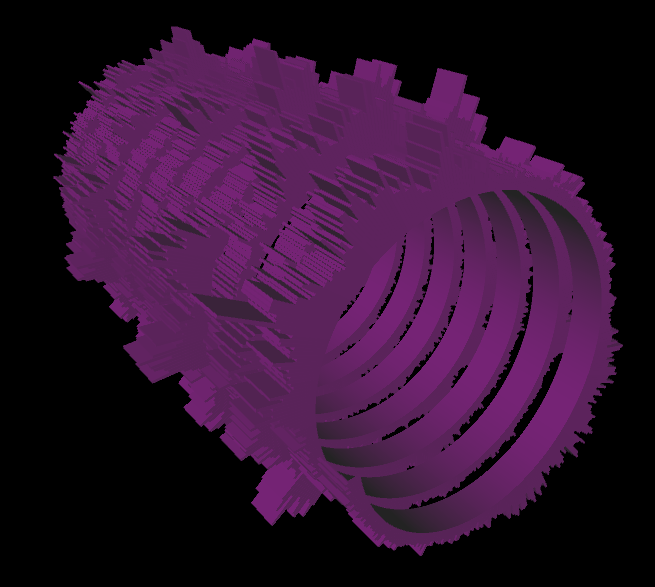
This is my suped-up version of the old flight404 and toxi Processing sketch - it uses Perlin noise to create a moving field of very organic-looking daggers.  toxi used it for hairs, and now I made an intricate version that uses 3D daggers drawn using OpenGL.

Noise Spears - PixelPusher (after toxi and flight404)

Noise Spears - PixelPusher (after toxi and flight404)

Read on for more plus source code

One Comment Digg del.icio.us

PopArt (a sketch)

by pixelpusher on Wednesday 6 August 2008
[Blog, Software]

PopArt Sketch 20080806

The first rule of blogging is to blog often.  So much for that. I’ve been traveling the world, and moving, and generally sans internet (that means “without internet” for all you non-French speakers).  In spite of this blog silence, I’ve been working on a lot of new things.  Like more experiments and sketches in Pop Art and Processing.   Here’s one (source code included):

PopArt 01

One Comment Digg del.icio.us

NYLON CityBlob

by pixelpusher on Thursday 5 June 2008
[Blog, Software]

A software art project that remixes the skylines and sights of cities I’ve lived in and visited. Download at: NYLONCityBlob

NYLON CityBlob

Awhile back, in 2006, I put my lifelong obsession with New York City’s buildings to good use. 2006 was the year my wife and I moved to London to start a new life as expatriates, reversing the colonial journey that started our home country in favor of the old country on the edge of a new, powerful-again Europe.

Leaving New York, I felt like a traitor. New York is in my family’s blood. My grandfather loved nothing more than to take us around the sights - the Empire State, the Twin Towers, Macy’s, the countless delicatessens shining as culinary diamonds in the rough preserve of Mexicans making Chinese food and Chinese baking Pizzas. My grandfather spent all his years in New York, knew every inch of the serpentine BQE (Brooklyn-Queens-Expressway) slithering over and through industrial Brooklyn on its way up north to upstate and sweet oblivion, finally exploding into the Hutch, the Cross-Bronx, and the Bruckner.

Not that he would have ventured that far north - he hated grass, and crickets. Especially crickets.

I don’t want to give the impression that my family is parochial; they’re well-traveled and world-wise, but they always come back. I still haven’t returned.

I ‘ve turned my world travels into an art project - just as the skylines of all the places I’ve visited and lived get jumbled in my head over time, this software remixes them and rescales them and blends them into a chimera of a city. I’ll add to it over time but right now it is NY (New York City) LON (London). Sometimes it gets intimate, and small places crowd out the big, important, impersonal ones. Use the mouse to navigate. Mac-only (for now). Enjoy.

If you’d like to show it somewhere, please contact me at pixelpusher@flkr.com, I’m open to the idea.

2 Comments Digg del.icio.us